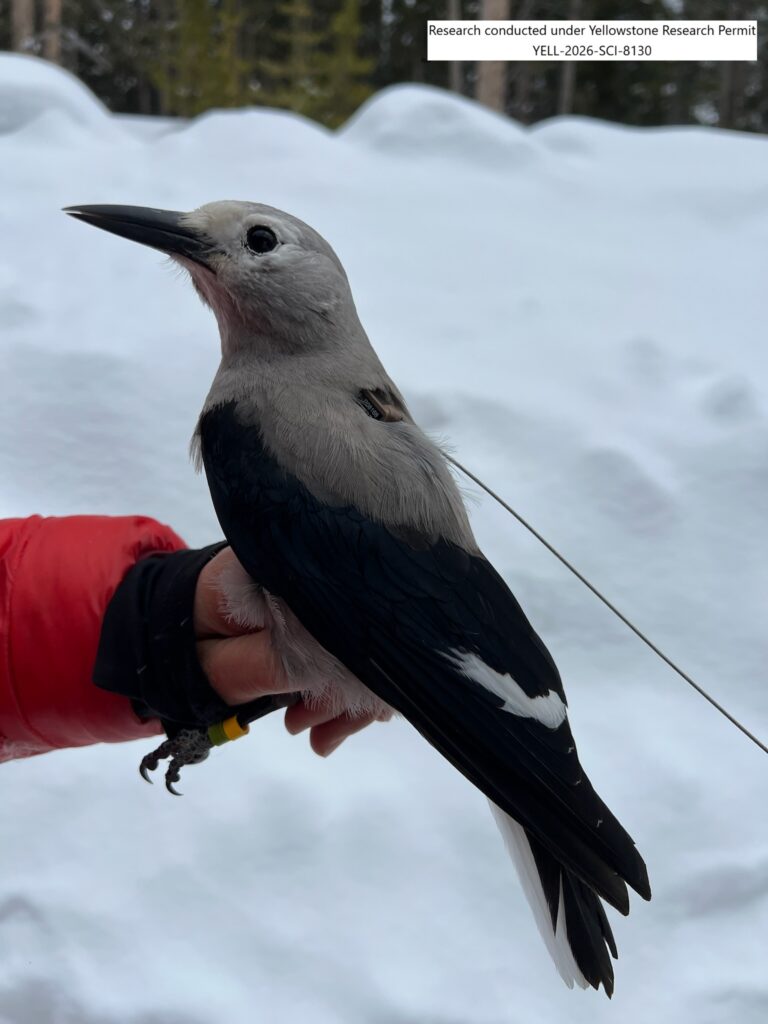
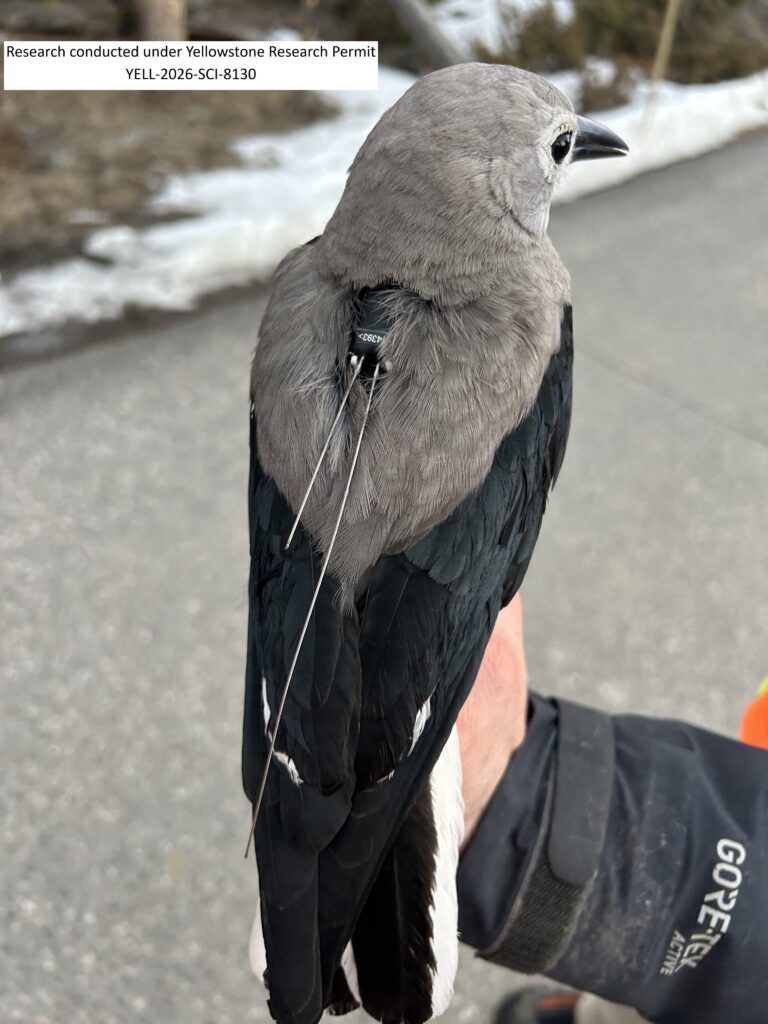
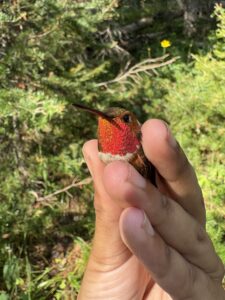
This spring, we’ve continued our work to capture and tag Clark’s Nutcrackers around Yellowstone National Park.
In 2020 the University of Colorado-Denver (UCD) and RCF attempted to capture Clark’s Nutcrackers in Yellowstone National Park. Our effort was interrupted when Covid shut down the park, but since then our work has developed into a multi-year project aimed at understanding movement patterns and habitat use of Clark’s Nutcrackers across the Yellowstone Ecosystem (YE). Since 2021, Ricketts Conservation Foundation staff have teamed up with UCD researchers to trap Nutcrackers in the park, from Mammoth Hot Springs, to the Lamar Valley, and south to Canyon Junction. We capture, band, and attach transmitters to individual Nutcrackers so that we can track their movements across the ecosystem in every season.
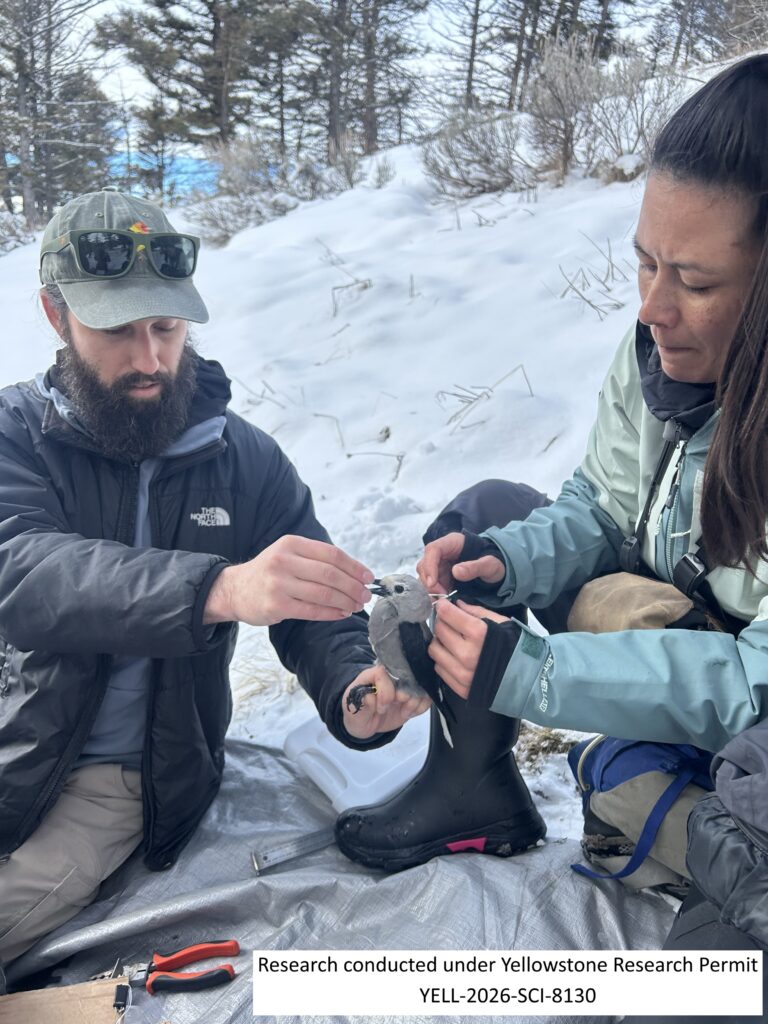
Our trapping approach remains straightforward and effective. Bait is deployed at selected sites and monitored over several days before traps are set. Steller’s Jays and Canada Jays frequently find the bait first, but once they arrive, we focus our efforts exclusively on nutcrackers. This year, we expanded our effort beyond park boundaries. We established new trapping sites in the Custer-Gallatin National Forest in Montana to expand our banding opportunities. This expansion is important, as the YE extends well beyond the park’s borders, and to understand nutcracker movement we need to sample across that broader landscape. This work proved successful, and we caught five individuals at one of our new locations.
In addition to capturing new individuals, we encountered birds that we trapped previously. Over the years, we have marked each captured bird with a unique color leg-band combination. This allows us to identify birds banded in the previous seasons and recapture individuals with old, non-functioning, transmitters. Upon recapturing these birds, we assessed their body condition and removed their units, reducing the load on the bird and allowing them to continue their lives unencumbered by the transmitter and harness. There’s something unique and special about releasing such a bird back into the wild after it carried a tag that contributed greatly to our understanding of its movements and habitat use.
With a new cohort of seven transmitters deployed in 2026, our project continues to build a growing dataset on annual nutcracker movement patterns and habitat use. As the dataset expands, so does our ability to better understand the ecological role of Clark’s Nutcrackers across the YE. Increasing our sample size will allow us to conduct more robust analyses of how these birds use the landscape and their primary food resource, the whitebark pine.