Awareness of Private Lands and Wildlife Migration

Here in western Wyoming, we are a part of an ecosystem unique to the nation, known as the Greater Yellowstone Ecosystem (GYE). This ecosystem is a vast area, spanning over 23 million acres across Wyoming, Montana, and Idaho. Ecologically, the GYE is considered primarily intact, remaining wild and open space, as over 70% of the land within it is owned by the United States Forest Service, Bureau of Land Management, and National Park Service. Most of this public land is considered high elevation with a short growing season. The higher elevation forests and alpine habitats remained unclaimed during the settlement of the West, and after the passage of the Forest Reserve Act of 1891, became protected federal lands and in 1907, National Forests.

Figure 1: Land ownership distribution in the Greater Yellowstone Ecosystem

Figure 1: Land ownership and its distribution throughout the Greater Yellowstone Ecosystem (GYE).

While private lands in Wyoming make up 13% of the GYE, they hold the key to critical habitat connectivity and health throughout the western half of Wyoming. During settlement of the West in the early 1800’s, settlers established their homesteads at lower elevations along existing streams and riparian areas, allowing them to divert water and create hay meadows to support livestock. When the settlers began irrigating, they inadvertently expanded riparian areas. Their hay meadows not only replenished local aquifers through flood irrigation but have altered the landscape such that they are vital for many wildlife species.

To understand why private lands hold a vital role in ecosystem health in comparison to public lands, one must understand the movements of native wildlife species. Large ungulates such as moose, mule deer, pronghorn antelope, and elk have natural migration patterns where these animals travel from winter range to summer range every year. Typically, summer range can be found in the high elevation lands of our national forests and parks. As snow accumulates, these animals migrate out of the high elevation habitats into lower elevations that have typically milder winters, crossing thousands of miles of fence on their journey. These animals depend on the riparian, wetland, sagebrush, and foothill shrubland habitat types that dominate our private lands for survival during the most stressful months of winter. Not only are these lands critical for ungulates, but because they are situated on perennial streams, management of private lands directly impacts the health of aquatic life and fisheries.
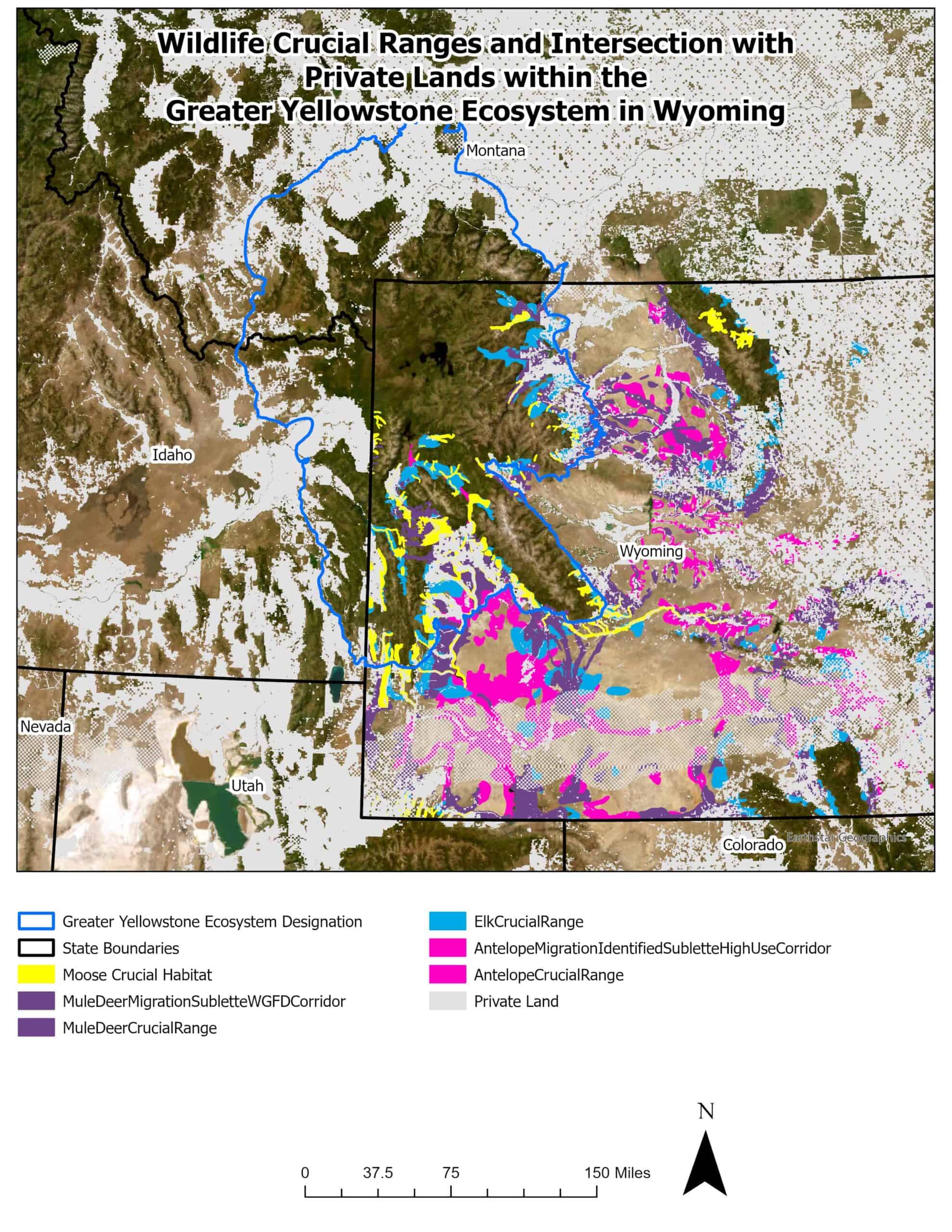
Figure 2: Crucial winter and summer ranges for Wyoming wildlife intersecting private lands

Figure 2: Crucial ranges for Wyoming wildlife and their intersection with private lands.

The heart of the Ricketts Conservation Foundation is a belief that conservation is everyone’s responsibility. The Natural Resources Conservation Service defines natural resource conservation as “the careful maintenance and upkeep of a natural resource to prevent it from disappearing. A natural resource is the physical supply of something that exists in nature, such as soil, water, air, plants, animals, and energy.”

Figure 3: Sunset on Tosi from the Hoback in Wyoming

Figure 3: Sunset on Tosi from the Hoback in Wyoming

Cumulatively, private lands hold a critical role in watershed and landscape health. Everything is interconnected, from the high mountain ridges to the valleys and open spaces below. Because of this, it is imperative for all landowners to understand the current state of natural resources on their property, no matter how large or small your ownership tract is.
Spring in Wyoming

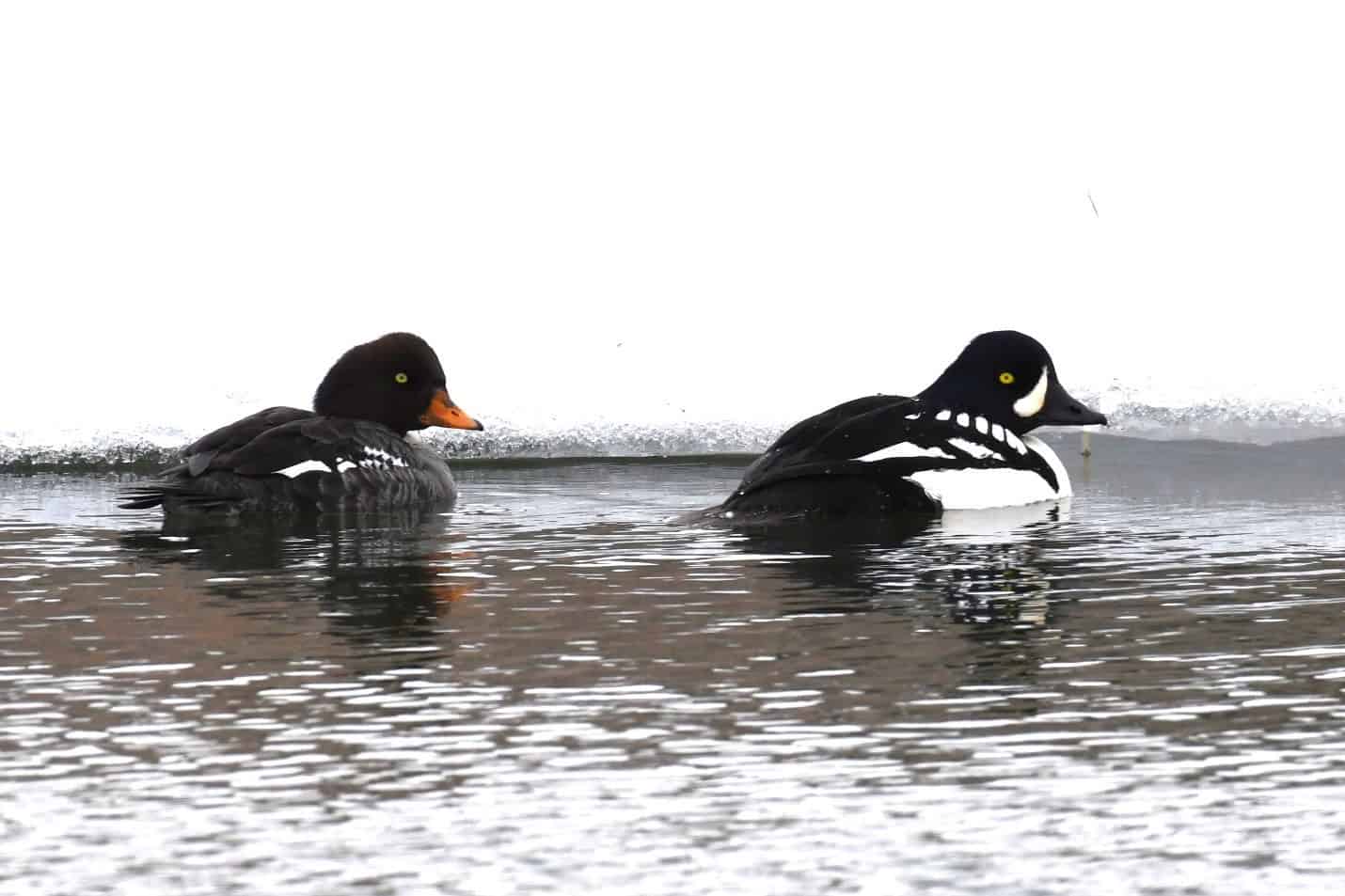
Spring is slow to come at 7,000’ elevation. According to our on-site weather station observations, the average temperature for the month of April was 32 degrees F., and May has had its fair share of snow showers. But as the snow and ice melted we received our first spring arrivals (Figure 1).

Figure 1: Female (L) and male (R ) Barrow’s Goldeneye

Figure 1: Female (L) and male (R ) Barrow’s Goldeneye

Barrow’s Goldeneyes show up as soon as there’s any open water around. These charismatic ducks are more common further north, but like several other species, the southern edge of their breeding range lies within the Yellowstone Ecosystem.

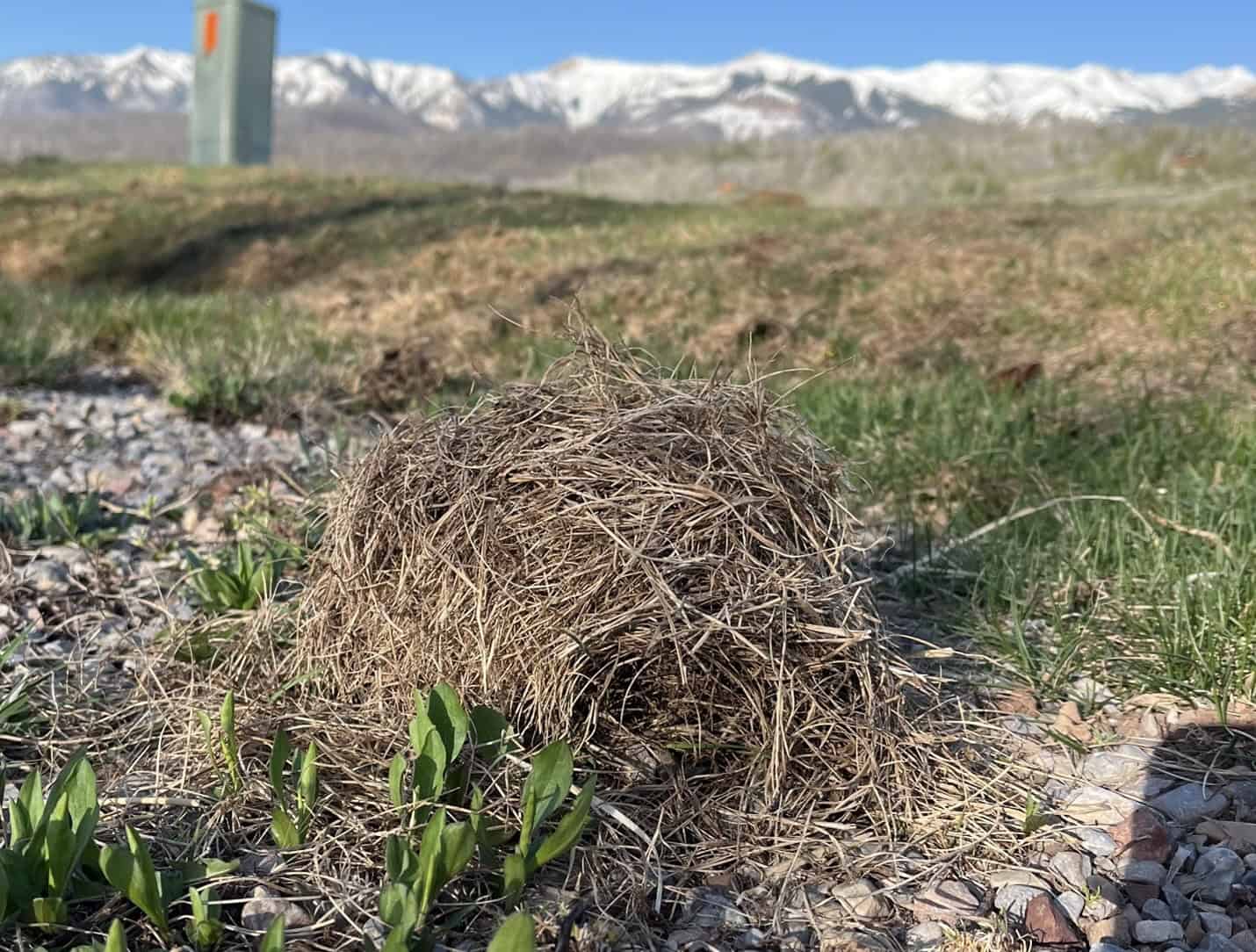
Figure 2: Probable vole nest exposed after snowmelt. Wyoming Mountains in the background.

Figure 2: Probable vole nest exposed after snowmelt. Wyoming Mountains in the background.

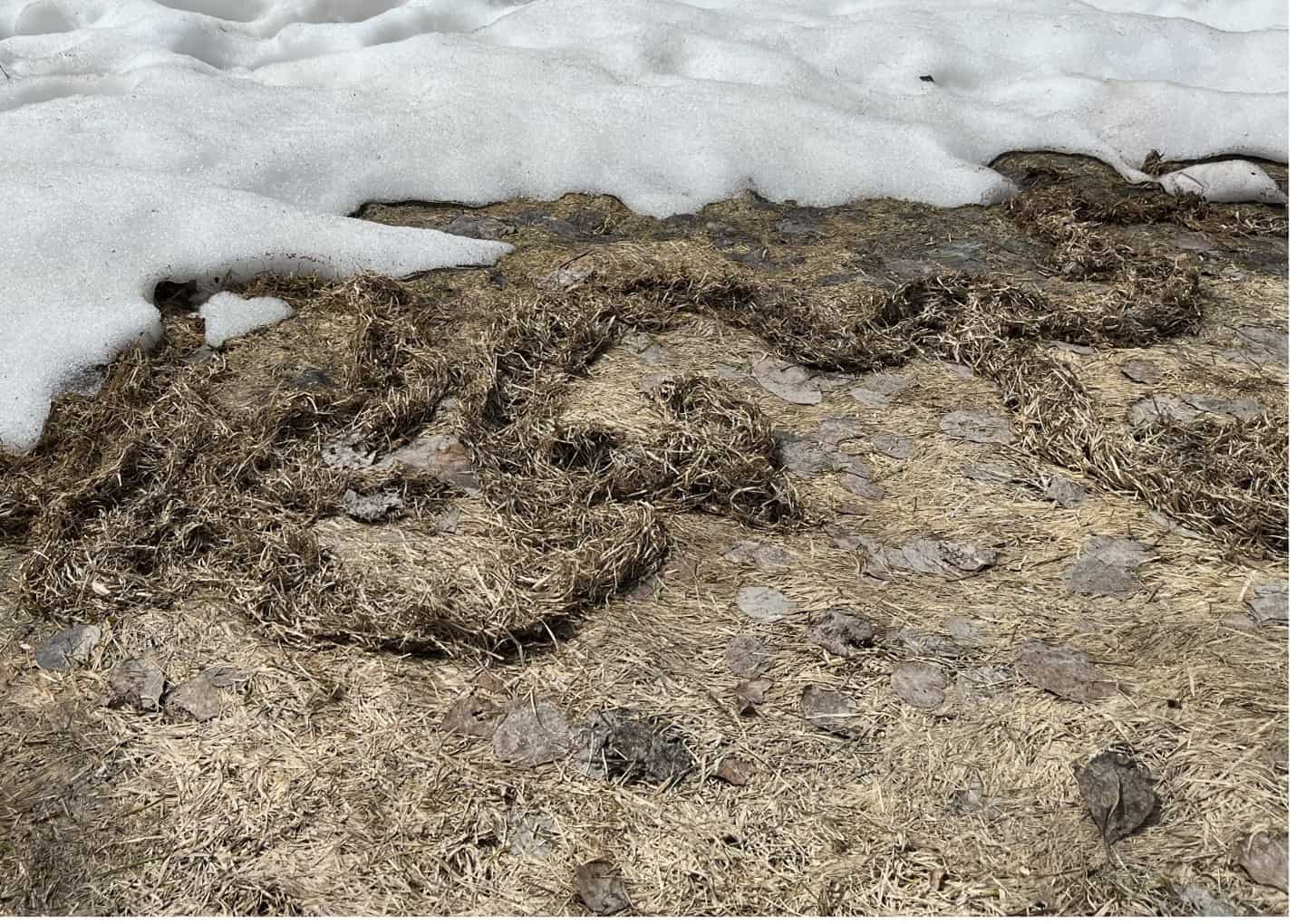
Other signs of life appear as the snow melts. The nests (Figure 2) and tunnels (Figure 3) that mice and voles created in the subnivean (under snow) zone during the winter are exposed. Surprisingly, the deep snows of winter create a safe and relatively warm habitat for small mammals.

Figure 3: grass-lined tunnels created by mice or voles exposed by melting snow.

Figure 3: grass-lined tunnels created by mice or voles exposed by melting snow.

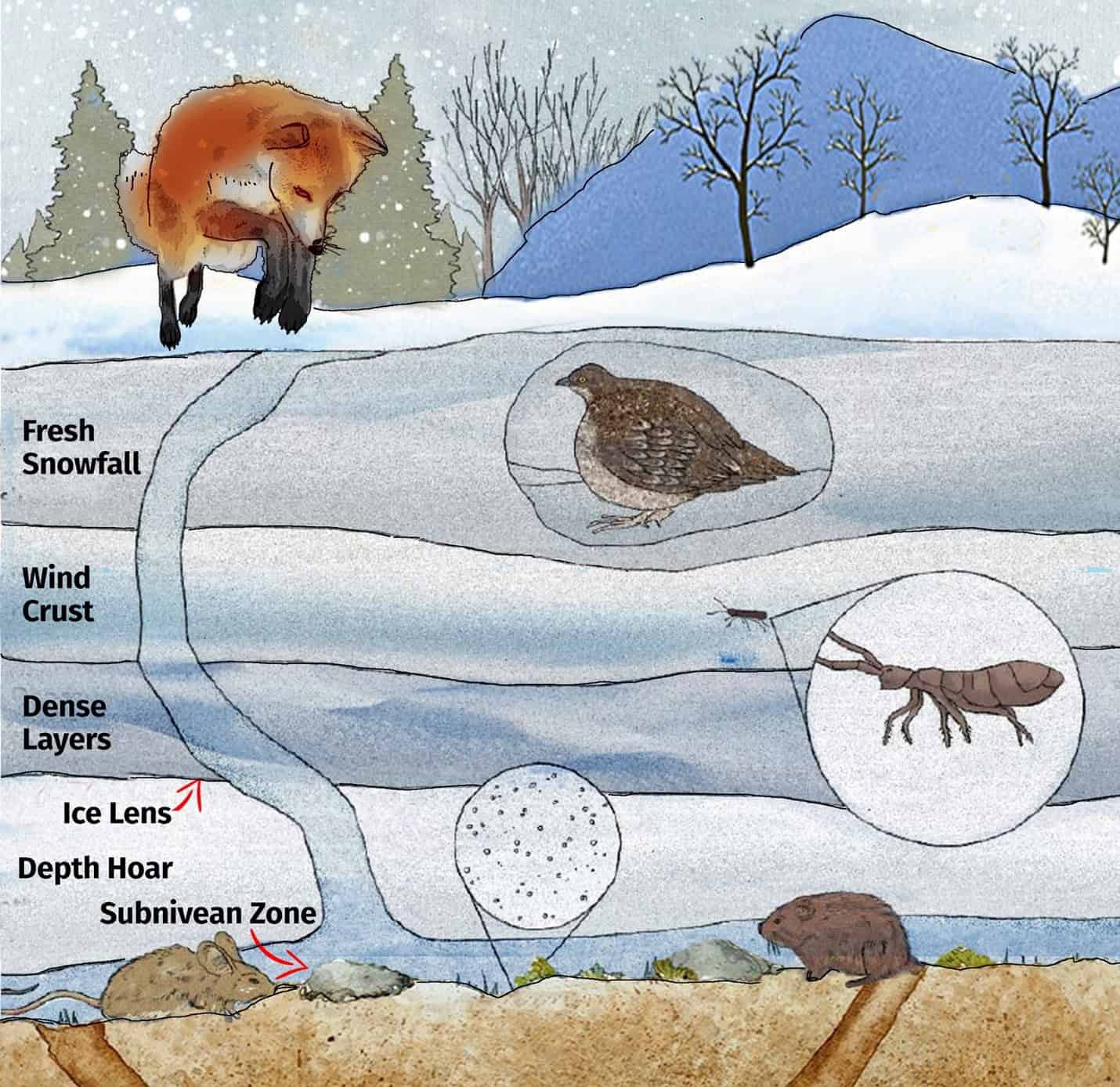
Once snow sticks to the ground, the layer in contact with the ground melts or sublimates, and the resulting water vapor rises into the snowpack, where it freezes and forms an icy layer (Figure 4).

Figure 4: The subnivean zone http://archive.audubonmagazine.org/truenature/images/ice_Castle-marcocibola-lg.jpg

Figure 4: The subnivean zone http://archive.audubonmagazine.org/truenature/images/ice_Castle-marcocibola-lg.jpg

The snow above the ice layer provides great insulation, so the resulting space between the ground and snow remains near 32 degrees throughout the winter. Protected from most predators by this blanket of snow, rodents and shrews are free to move around at will. Some species even breed during winters as it can be safer to do so then than during summer. However, life is never risk-free for small mammals. Short-tailed weasels hunt them in their tunnels, while red fox and Great Gray Owls use their hearing to locate and then pounce on them. But on balance, life is safer for rodents in winter, as evidenced by the southward migration of most of the raptor species that prey on them from spring through fall.

Give a Hoot

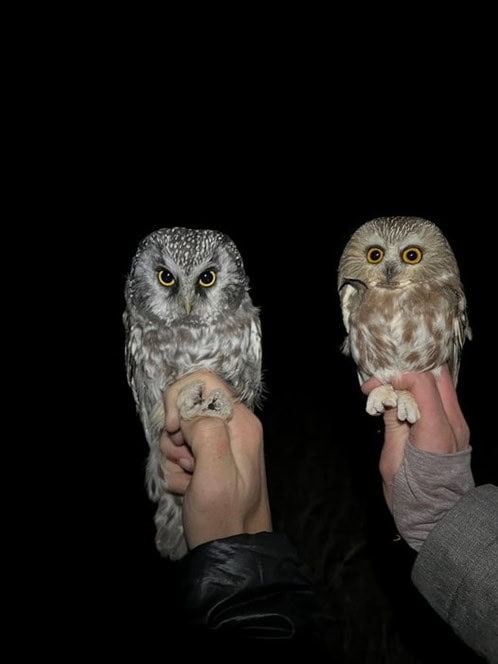
Several species of owls breed near or migrate through the Upper Hoback River Valley. Most hunt small rodents that they capture using their keen vision and hearing. Each fall, two of the smaller species, Northern Saw-whet Owl and Boreal Owl (Figure 1), migrate to lower elevations to avoid the deep snow that provides a protective blanket under which mice, gophers, and voles thrive in the resulting subnivean layer during our long winters (link to next blogpost).

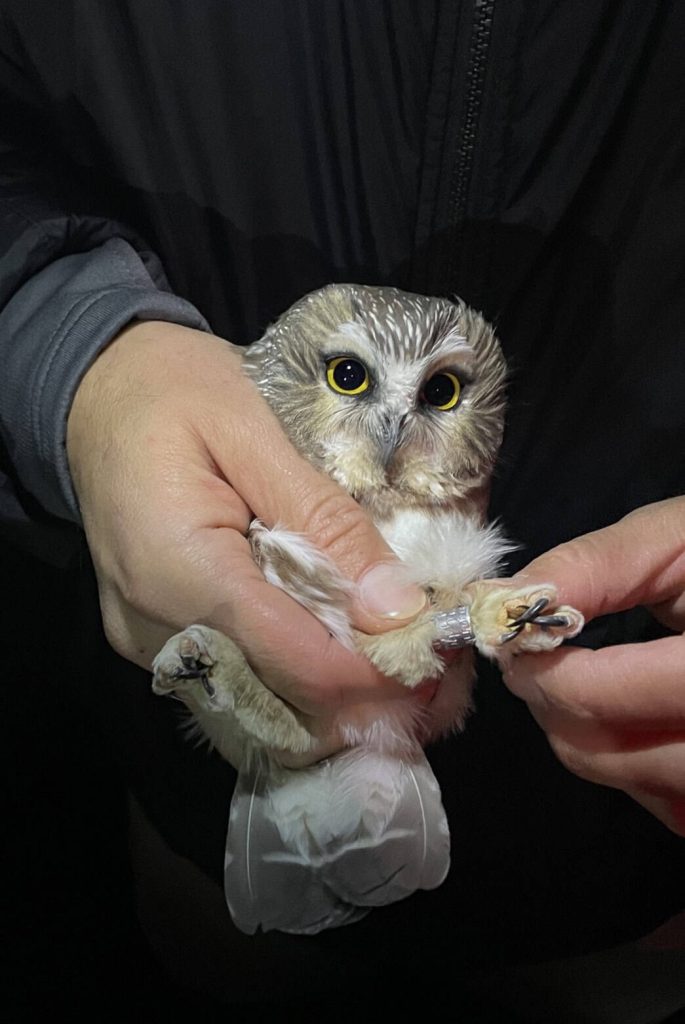
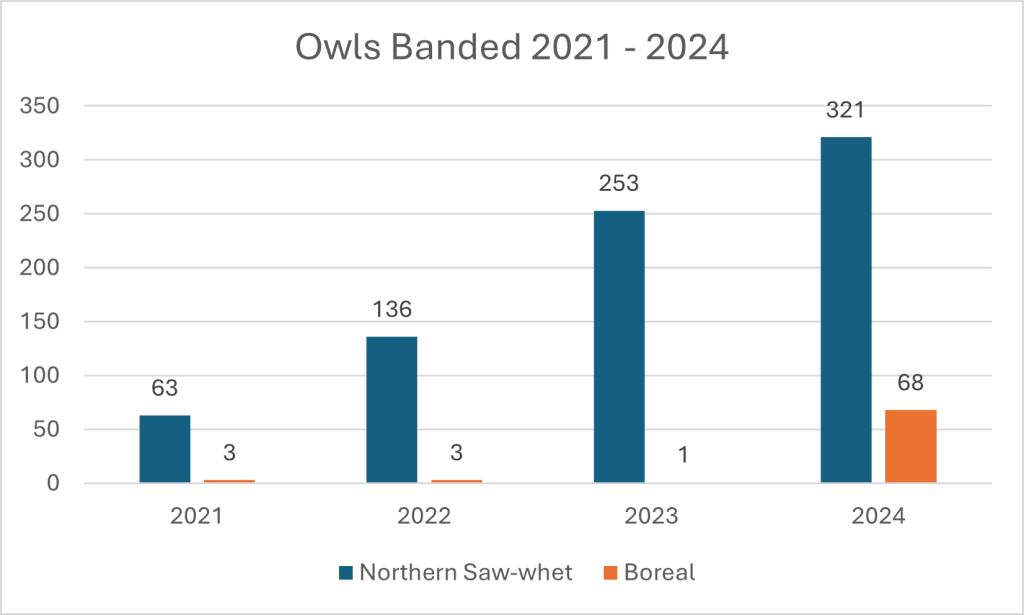
We can capture these owl species during fall migration by placing mist nets around a loudspeaker and playing male owl territorial calls on it (Figure 2). In 2021, Ricketts Conservation Foundation biologists decided to find out if Northern Saw-whet Owls migrated past the ranch in fall. Sixty-three birds later, we had our answer. Since then, we’ve continued our efforts and captured 773 Northern Saw-whet Owls through the end of 2024 (Figure 3). This past fall, we opened a second banding site for Boreal Owls and captured 68 individuals. This was probably the highest number of Boreal Owls captured at a single banding site in the lower 48 states.

Our reason for conducting this work is better to understand the movement patterns of these two species. Organized banding of Northern Saw-whet owls has been done in eastern and central North America for over thirty years, and we follow a capture protocol established by Project Owlnet. We also have state and federal permits to conduct this work. Before we started our banding effort, there was no sense of how many owls migrated across western Wyoming. We now know that significant numbers of birds move past us every fall. The question is to find out where they’ve come from and where they’re going.

To answer the first question, we’ve collected feathers from captured birds and sent them to Colorado State University. We’re partnering with other banding sites to provide the Bird Genoscape Project with samples that can be used to identify different populations of owls and determine where they breed. This has significant conservation implications as we can then identify populations that may face challenges to their survival.

It's harder to find out where they’re going. Back East, there are multiple banding stations, so it’s common to capture birds banded at other sites and thereby gain an understanding of regional movements. We don’t have this opportunity because there are few owl banding stations in the Intermountain West. Instead, beginning in fall 2025, we plan to place transmitters on up to 15 birds that will provide us with GPS locations for up to two years. We can follow both owl species to their wintering and breeding grounds if successful. Stay tuned!

Figure 1: Boreal Owl (L) and Northern Saw-whet Owl (R )

Figure 2: A banded Northern Saw-whet Owl. All birds are captured, processed and released using established protocols by banders with federal and state permits

Figure 3: Number of Owls Banded at Jackson Fork Ranch

The Early Bird Gets the Ice

When most people imagine scientific research they think microscopes and lab coats. When thinking of conservation they picture park rangers and polar bears. If people even consider loon conservation, they might imagine artificial nest rafts or aluminum fishing boats. These assumptions play a role in loon work, but when we try to study and conserve the loons of the Greater Yellowstone Ecosystem (GYE) there’s more to consider. An ecosystem of nearly 20 million acres of land[1] marbled with towering mountains and dramatic canyons, a whopping 12 feet of annual snowfall,[2] and nearly 7 million annual human visitors in its national parks alone[3,4], the GYE is flush with curveballs for the collaborative effort to monitor and protect its uniquely isolated Common Loon population.

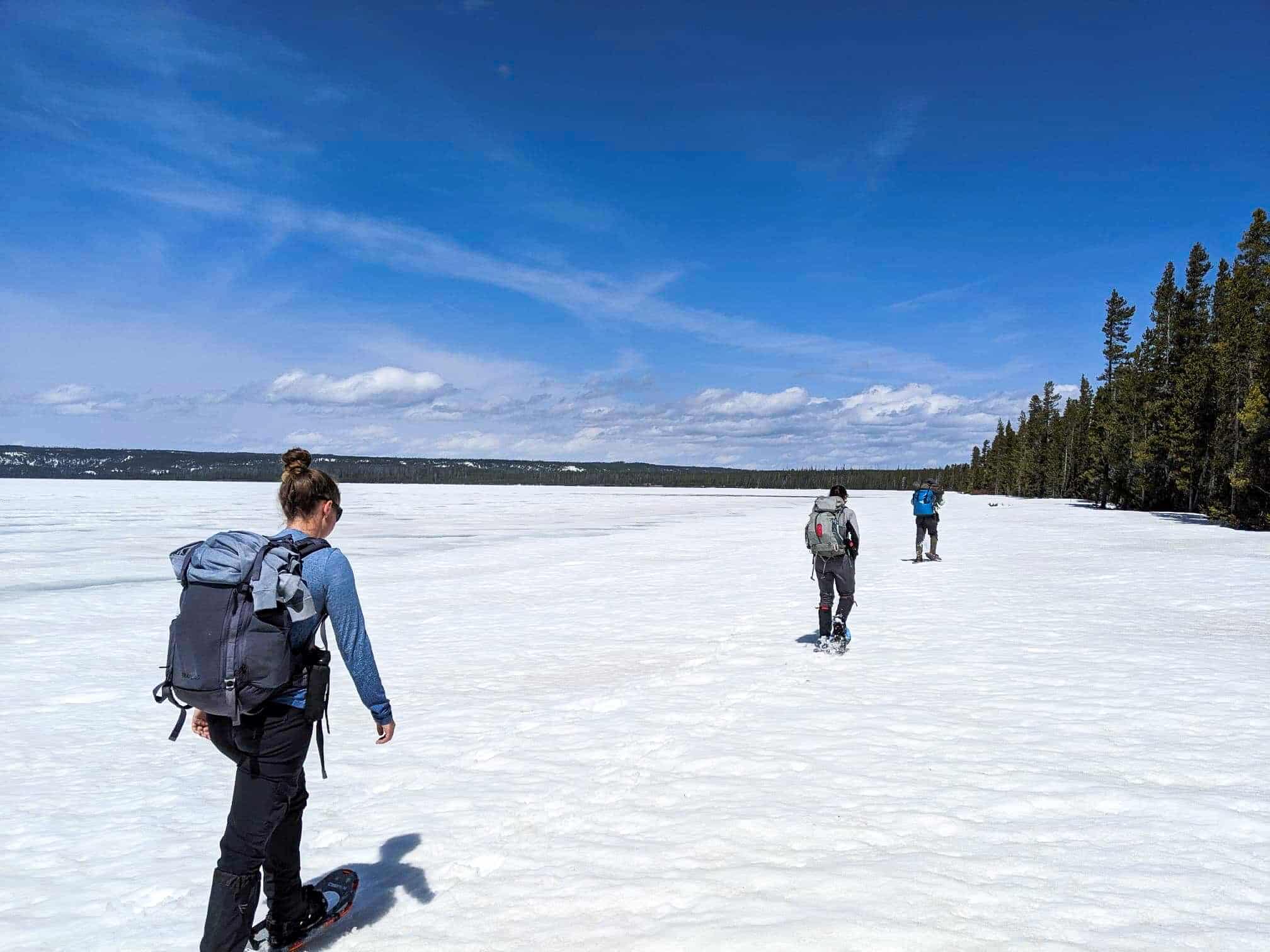
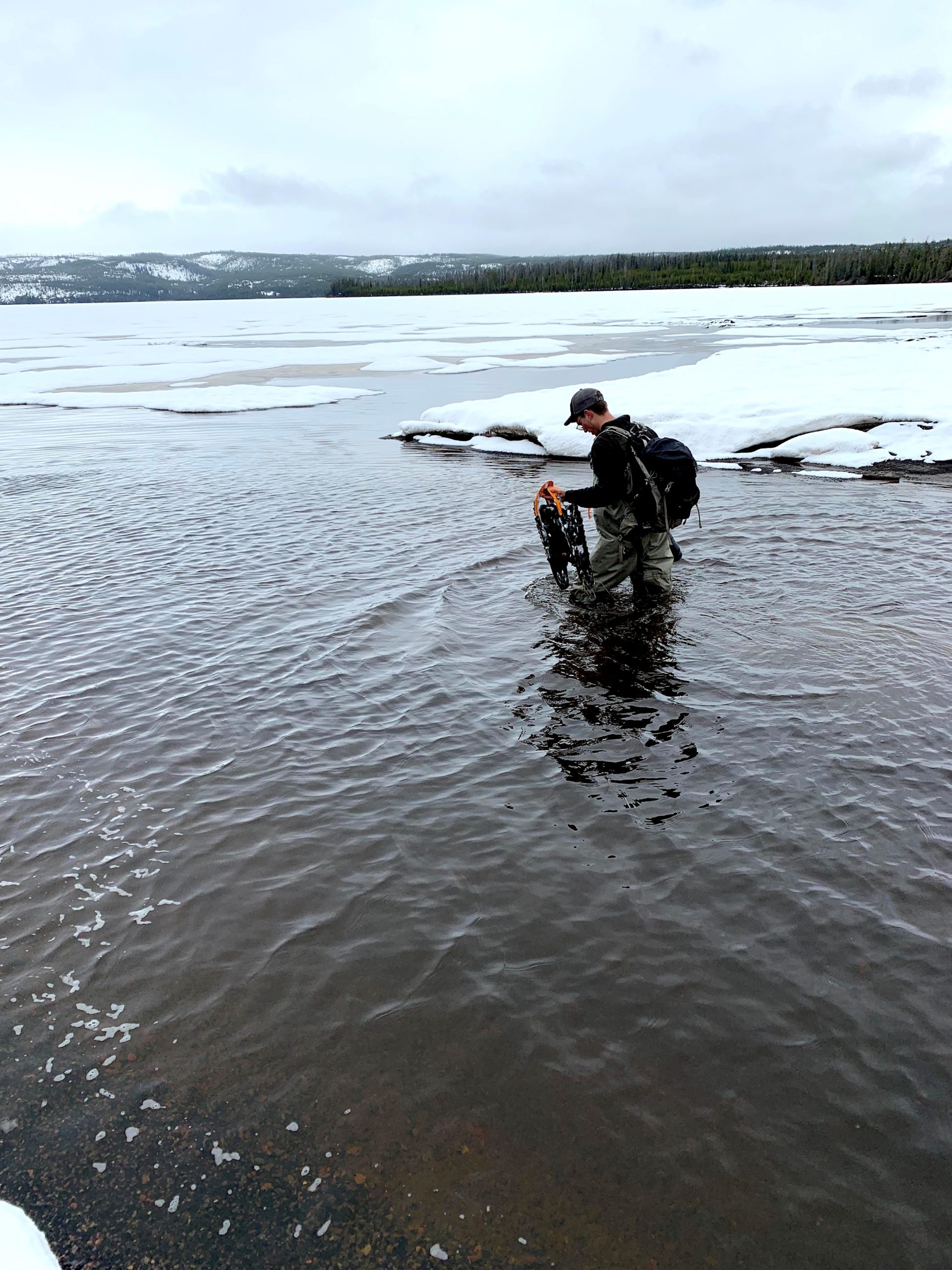
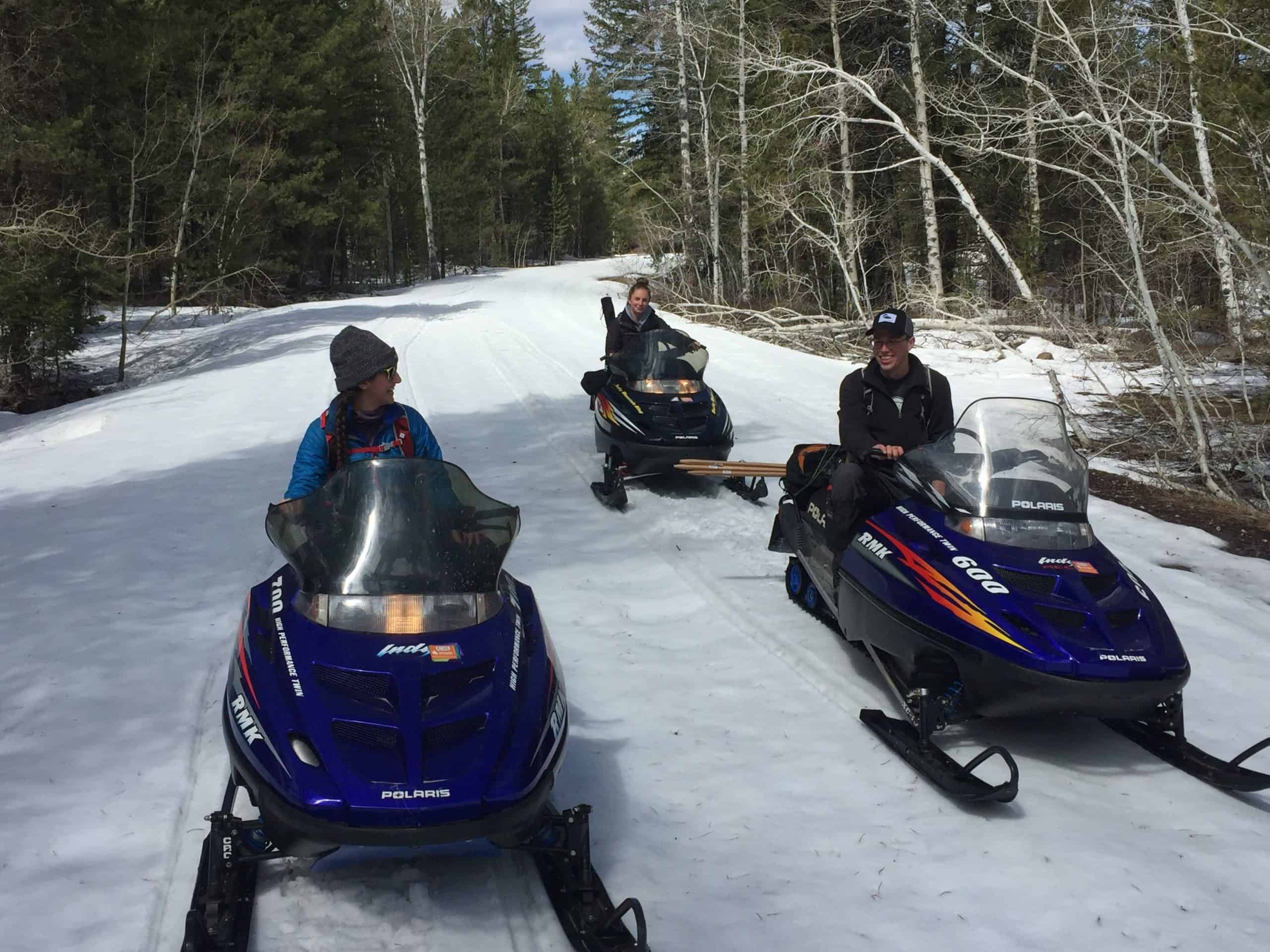
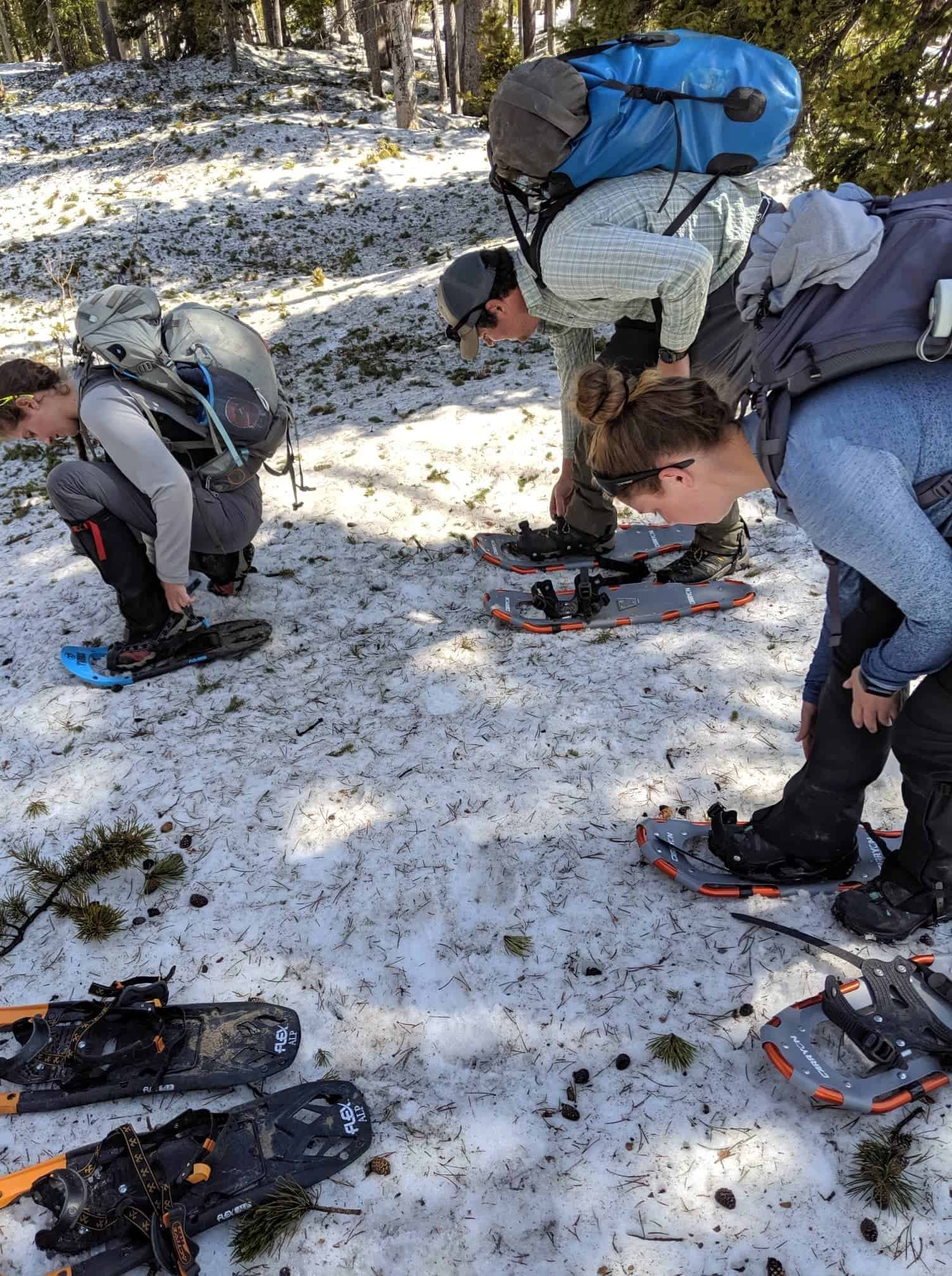
Add in a late winter, and loon work really gets challenging. As spring blossoms and temperatures warm in April, loons make their way from comfortable southerly wintering locales along the Pacific coast to the loons’ breeding grounds in the GYE. In April of 2019, however, the GYE greeted the loons with heavily iced over lake territories and the RCF loon team with impassable roads and a solid 3 feet of snowpack. This might seem like terrible news, but thankfully, loons are proactive -- they make frequent reconnaissance flights from nearby open water to determine the ice conditions of their territories to ensure that they will be the first to (re)occupy and claim them for the breeding season. For our team, this meant incorporating snowshoes and snowmobiles into our daily hiking routines as we trudged around to monitor the breeding and nesting progress of the loons. As temperatures rose, it meant challenging half-frozen stream crossings, sometimes on snowmobiles, and frustrating guesswork with our nest disturbance camera monitoring.

What does this all mean for the loons? As an easily disturbed species, small changes to their breeding timeline can have cascading effects on nesting success and productivity. In the context of the late winter of 2019, this climatic fluctuation led to early-season congregations of loons on open areas of the larger GYE lakes. In one brief sitting that May, our crew counted nearly 40 loons on the north end of Jackson Lake, preening, resting, and feeding. Some were probably northward migrants en route to Montana, Alberta, or Saskatchewan, but there were very likely local GYE loons among them waiting for their lakes to thaw. By May 26th that year, we still had two territories completely iced over!

In 2019 the late thaw meant that loons delayed their nesting, leading to more visitors visiting lakes when loons were incubating their eggs and most vulnerable to disturbance. The late snowpack also delayed our placing signs before the loons began nesting letting people know which areas were closed to human activity. Human disturbance is frequently a suspected cause of nest failure among breeding pairs in the GYE. Because the vast majority of visitors don’t know loons are present, let alone that their recreation choices can disrupt the loons’ normal nesting patterns, it’s extremely important to have educational signs in place by May. While some nests did fail last year, the season still ended with a level of productivity that should lead to continued growth for this small population (see prior blog post “17 Is a Big Number”). Even more exciting, several territories with a history of nest failure had surviving chicks last year -- a sign that management and closures put in place by the National Park Service, United States Forest Service, and Wyoming Game and Fish Department, in collaboration with RCF, are working to conserve these charismatic birds!

While the snowfall added new challenges to the 2019 season, working in the GYE always presents obstacles -- navigating mountainous terrain, mercurial weather, unexpected delays caused by wayward bison, and last, but not least, the futile task of trying to set a schedule based on the whims of unpredictable birds. Late winter or not, in 2020 the team has entered the season prepared to run the sleds again. Here’s hoping for a hasty thaw.

  1. Greater Yellowstone Ecosystem – TPL
  2. Yellowstone Weather – NPS
  3. NPS News on Visitation
  4. Annual Park Recreation Visitation Report
RCF loon team snowshoeing to a loon territory

RCF loon team snowshoeing to a loon territory. Photo by Charlie Southwick.

RCF staff member fording river

RCF staff member fording river on hike to a loon territory. Photo by Vincent Spagnuolo.

RCF crew using snowmobiles

RCF loon crew using snowmobiles to access remote loon lakes. Photo by Vincent Spagnuolo.

RCF crew gearing up

RCF loon crew gearing up for a hike to a loon territory. Photo by Charlie Southwick.

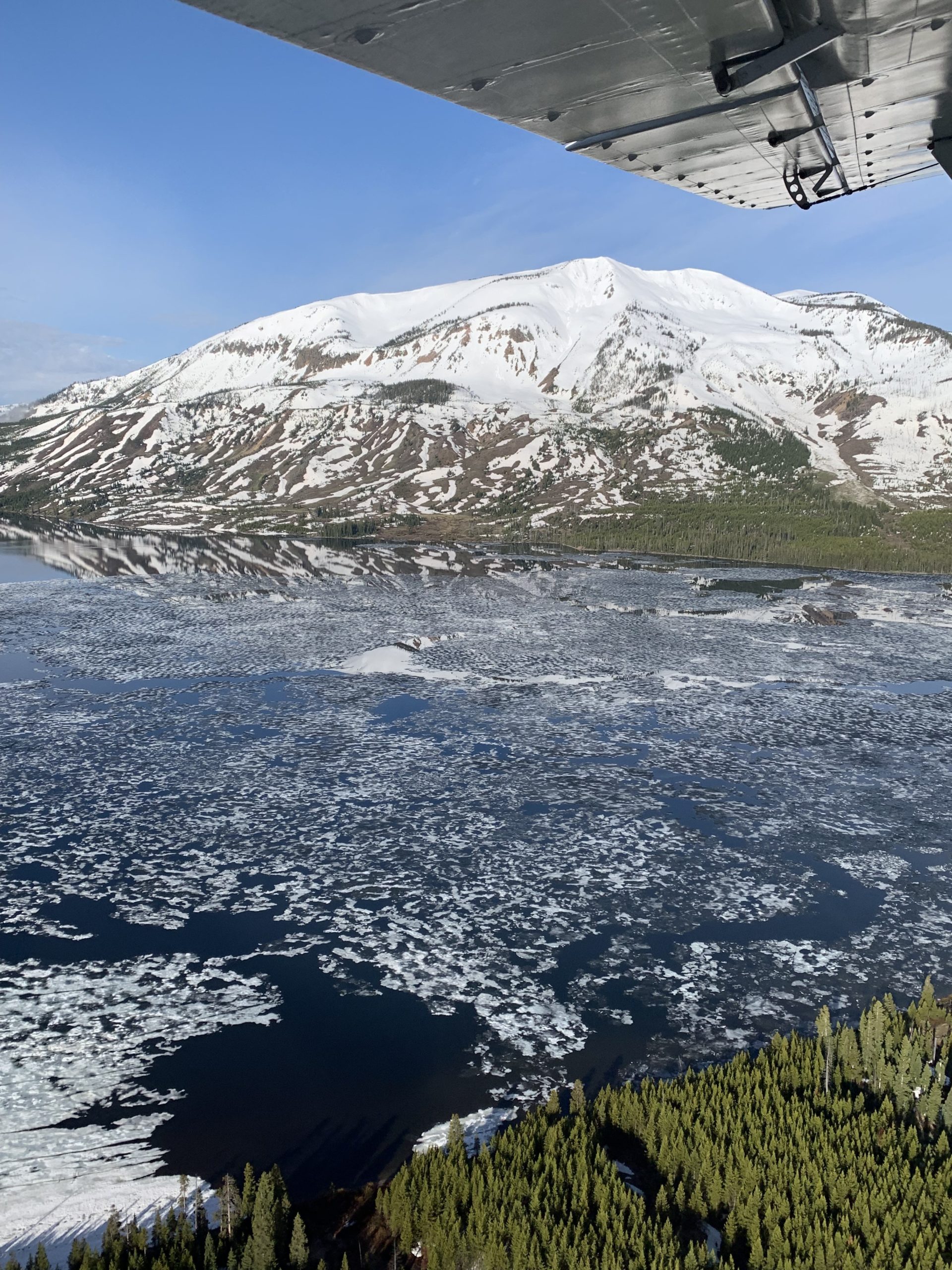
Aerial view of loon-occupied lake

Aerial view of lake occupied by loons in Yellowstone National Park. Photo by Vincent Spagnuolo.

Sometimes 17 Is a Big Number

The number 17 does not come to mind when you think of big numbers, but when you’re working with Common Loons in the Greater Yellowstone Ecosystem (GYE), an isolated population numbering only 22 territorial pairs, small numbers like 17 can be relatively massive. This “big” number was important to the Ricketts Conservation Foundation’s Loon Study team because it was the number of chicks surviving at the end of our field season in the GYE! To give some context, it is the third most chicks observed in a GYE loon breeding season since monitoring began in 1989 (21 in 1989 and 18 in 2014). When you’re trying to keep a small and isolated population of loons from blinking out of existence, productive years like the one we observed in 2019 are critically important and every single loon chick counts! This is why the Ricketts Conservation Foundation is working hard in collaboration with all our state and federal partners in the GYE to understand the population and mitigate threats to nesting and survival.

Loon Family

Photo Credit - Daniel Poleschook

One of the most critical threats to the GYE loon population is human disturbance of nesting loons which can cause loons to flush off their nests leading to abandonment, depredation of the eggs by predators, or egg inviability due to exposure to the elements. Many loon territories in the GYE have had difficulty hatching chicks in recent years, and even one human-caused nest failure has a serious negative impact when working with such a small population! This past season we assisted the Wyoming Game and Fish Department (WGFD) and the Caribou-Targhee National Forest (CTNF) in developing 2 new closures and improving 3 existing closures to protect nesting loons across five lakes in the forest. We relied upon years of observational data, nest site locations, and trail camera research to inform the design and duration of each closure. These closures are temporary and are only in place during the nesting period when loons are the most sensitive to human disturbance. Some closures involve just closing off a portion of the lake like a cove, island, or section of marsh, while others require closing off the entire lake to boating or shoreline activities. You may see some of these loon closures in the CTNF as well as other loon closures across the GYE in the early summer as they’re well marked with posted signs and buoys.

Closure Buoy

Similar to the success targeted closures have in other parts of the loon’s range where conservation efforts work to protect nesting loons, these five closures resulted in four of the territories successfully hatching a total of seven chicks! The one pair to not hatch, unfortunately abandoned their nest due to unknown reasons. We still feel that four out of five is great and 80% can be considered a big number! To add perspective on the effectiveness and importance of these closures, in 2018, a voluntary closure was enacted at Moose Lake in the CTNF which resulted in the first chicks at that territory since 2003! The pair went on to hatch two “big” chicks this year with the improved and non-voluntary closure. Not only is there the obvious benefit of successful nests producing chicks, but minimizing human-caused nest failures strengthens loon pair bonds thus improving territory stability in the region, an important aspect of encouraging natural productivity levels and population dynamics. While this early success is promising, it’s important to note that no two lakes are the same and similarly, closures can be very different in design and approach. We’ll continue to work with the agencies to evolve the closures to be effective for loons while also minimizing the impact on human access and recreation.

Closure Map and Sign

It’s well known that loons are threatened by human impacts across their breeding range, particularly along the southern edge where human populations are the densest. While the GYE loon population is fortunate that development-related issues are less of a concern due to the protections of the National Parks and National Forests, it still must share the landscape with the human residents of the GYE and the millions of visitors drawn to the area each year. Targeted and informed conservation actions like these closures help humans and loons share the lakes and preserve the natural integrity of the GYE. We’re proud of these successful efforts to protect loons and commend our agency partners for their work to ensure the persistence of this population. We’re hopeful that together we’ll create a conservation scenario that leads to more “big” numbers of loon chicks in the coming years!

Fast Growing Cygnets

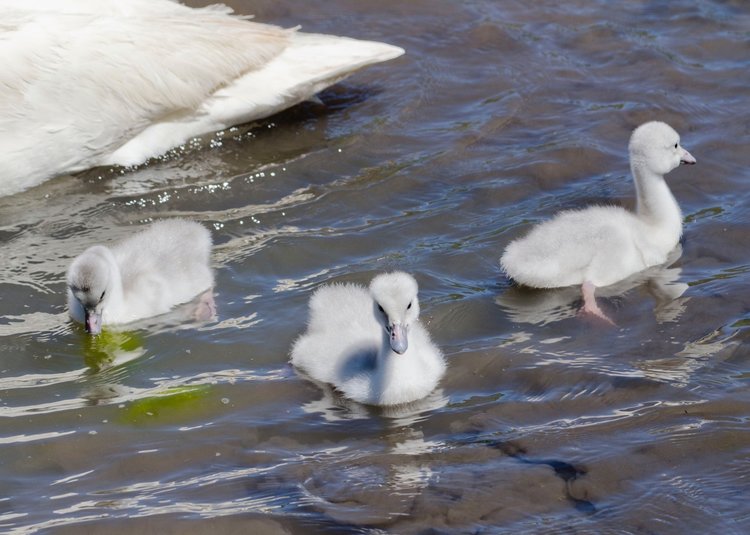
These cygnets are less than two weeks old and weigh no more than two pounds. Within the next three months they will have grown a full set of feathers and weigh more than 20 pounds. The energy required to fuel such growth is huge. Not only do the young need lots of calories, they require significant amounts of protein to build their muscles and feathers.

While the adults don’t feed their young, they do make it easier for them to find the nutrition they require. The plume of mud you see in front of the middle cygnet has been produced by its parent, in the background. The small waves coming off the adult are due to her paddling her large webbed feet back and forth, stirring up the bottom sediments and bringing vegetation and protein-rich invertebrates to the surface. The cygnet on the left is eating some aquatic vegetation that was stirred up off the bottom and came to the surface. The parents will continue helping their young in this way until they’ve grown large enough to use their long necks to reach the bottom on their own.

Cygnets feeding in stirred-up water

Devoted Parents

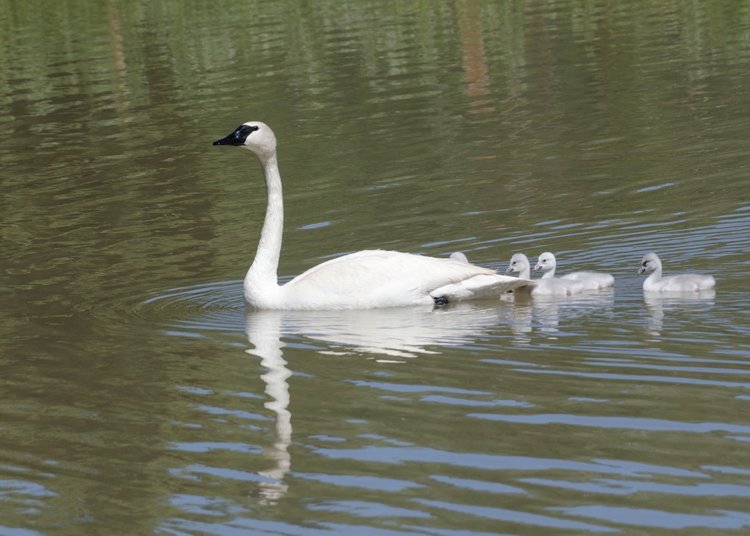
Trumpeter Swan with cygnets

Trumpeter Swans are very devoted parents. They spend almost all of their time tending to their brood, finding good feeding spots and making sure that any potential predator keeps its distance. The local Uinta ground squirrels have learned that an attacking swan means business. They’re also very observant and keep track of their surroundings. One example is that our captive birds are very cautious with people they don’t know. This parent is suspicious of the person with the camera, as I’m not someone who they’ve seen before. The cygnets are staying close to mom and don’t wander far.

One of the main benefits of raising our birds under semi-natural conditions is that they don’t become excessively habituated to humans and maintain a healthy skepticism about our motives. These traits will serve the young swans well when they’re released as young adults.