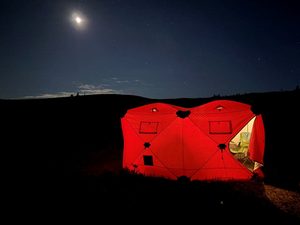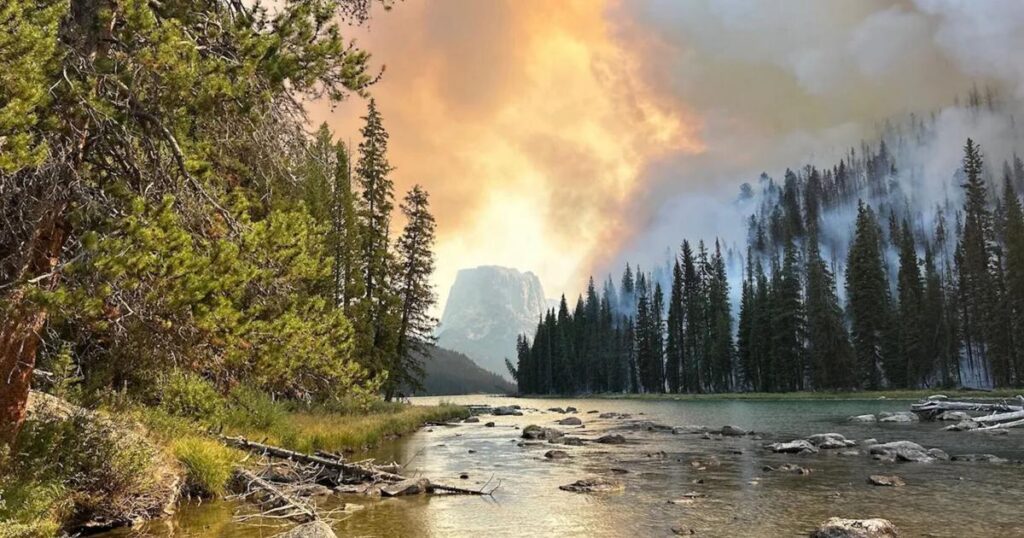
On August 21, 2025, a summer thunderstorm developed across the western Wyoming skies. The area was ripe for wildfire as there had been little rain in the region since spring. We distinctly recall this storm, because the cell moved eastward across Jackson Fork Ranch during the Saving Yellowstone Conservation Summit. Not long into the afternoon sessions, cell phone emergency tones began sounding in the tent, warning of a nearby fire. As the afternoon progressed, Summit participants could see an expanding plume of dark smoke, 28 miles to the northeast of us. While we were not in harm’s way, others were.
As is the case with most late-summer forest fires, the Dollar Lake Fire was most likely lightning-caused. Burning in thick timber on the Bridger-Teton National Forest’s (BTNF) Pinedale Ranger District and driven by strong winds, it burned 600 acres within hours. It eventually grew to over 19,000 acres according to the Teton Interagency Fire incident management page (Figure 2).
The aftermath of a wildfire presents a unique opportunity for positive collaboration among multiple user groups with a strong connection to the resource. Fire is an important part of landscape ecology and must be considered as part of the United States Forest Service’s (USFS) multiple use management mandate. There are many factors that play into fire recovery, where multiple use encourages collaboration, finding solutions that build relationships, exploring different opportunities for wildfire recovery, and leveraging funding from different sources to mitigate or offset costs for lost and damaged infrastructure.
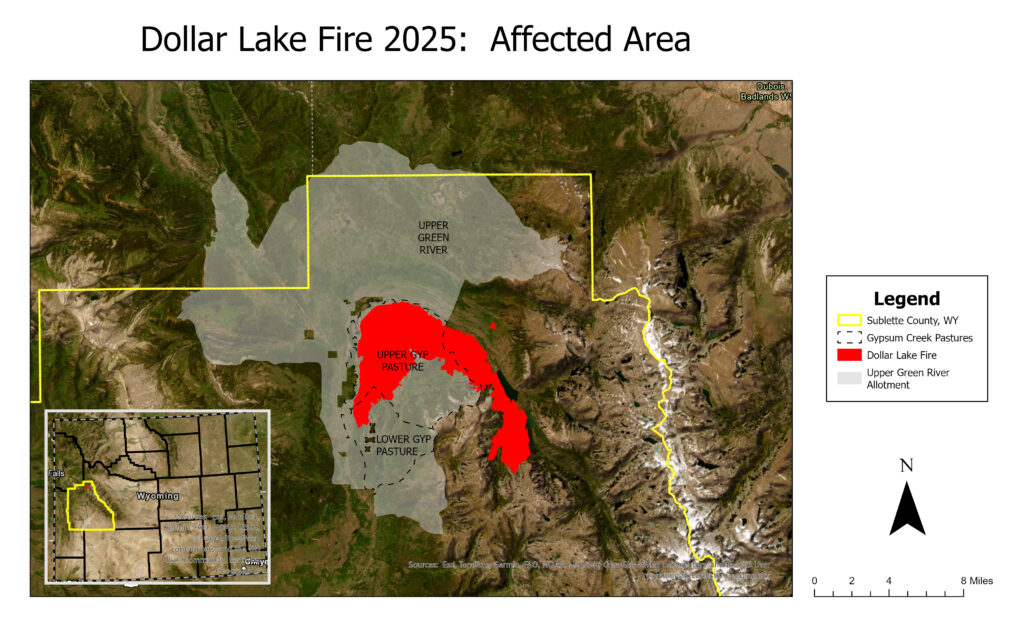
The USFS requires that livestock on permitted grazing allotments be excluded from burned areas for a minimum of two years, or until 60% of vegetative ground cover is achieved in the area burned. However, wildfires often don’t burn landscapes evenly, nor do they discriminate against jurisdictional boundary lines, or fencelines. In the Dollar Lake Fire, the burned area covered only a portion of two different pastures within the allotment, leaving unburned vegetation available for livestock consumption. The fire also burned several miles of physical fencing. Replacing them by the onset of grazing season was unreasonable, which left the permittees with few practical options that would allow them to graze the area in 2026.
One out-of-the-box solution suggested when reviewing options for the 2026 grazing season was the use of virtual fencing. Along with a modified livestock grazing rotation and stocking rate, permittees chose to explore the idea of virtual fence technology to exclude cattle from the burned area.
In 2024, the Ricketts Conservation Foundation established the Virtual Fencing Conservation Initiative and partners with producers on a variety of projects scattered across the Yellowstone Ecosystem. Virtual fencing is where livestock are fitted with a GPS collar that is programmed with “virtual” fences, or perimeters, within which livestock are contained. This prevents them from accessing burned areas, allowing for adequate vegetation recovery.
The Ricketts Conservation Foundation is thrilled to partner with the permittees, the Sublette County Conservation District, and the USFS in 2026 and 2027 on the Dollar Lake Fire virtual fence implementation. Using virtual fence to exclude livestock from grazing the burned area is key. This will result in two years of grazing deferment, allowing for successful wildfire recovery in the area. Equally important, the collaboration creates an opportunity for livestock producers to implement a novel technology year-round. The economic, social, and conservation benefits on private land can be further explored by both livestock producers and the Ricketts Conservation Foundation using the captured results. We hope that this approach of simultaneously addressing the concerns of land managers and producers can become more widely used within the Yellowstone Ecosystem and beyond.